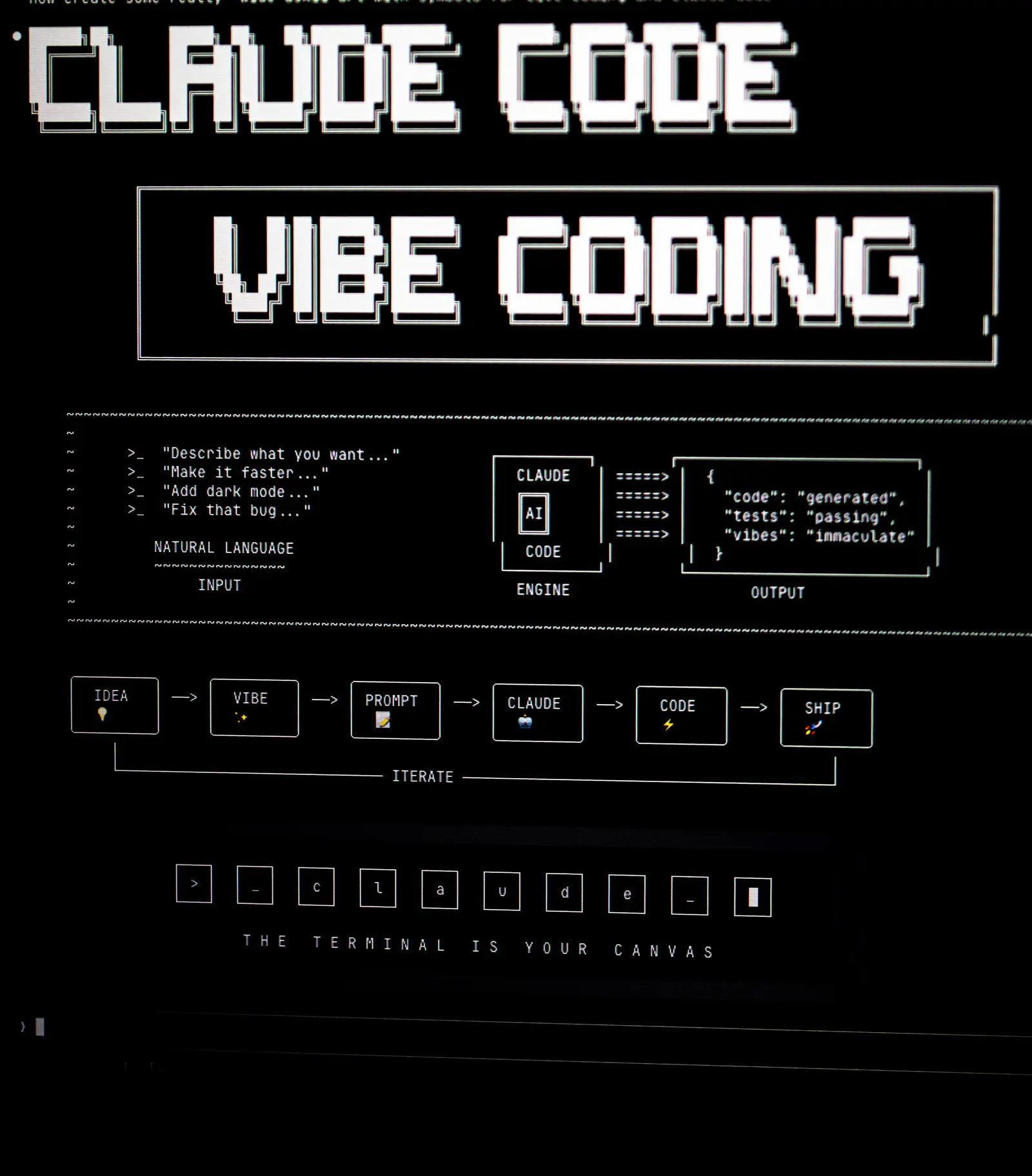
For about a year, "vibe coding" was the phrase everyone loved and nobody could define. You described what you wanted, an AI wrote it, and if it ran, you shipped it. It felt like magic. Then the bills came due — the security holes, the code nobody understood, the features that worked in the demo and fell apart in production.
So now the pendulum swings the other way. Vibe coding is dead, the headlines say. Real engineers don't let a model touch their codebase.
Both takes are wrong.
What vibe coding got right
The instinct behind vibe coding was correct. Describing intent and letting a machine handle the mechanics is genuinely faster. For a prototype, a throwaway script, or a proof of concept you'll rewrite anyway, it's the right tool. We use AI this way every week, and it saves real time.
The problem was never the AI. It was treating "it runs" as the same thing as "it's done."
Where it fell apart
Production has requirements a demo never sees. It has malicious users. It has edge cases, load, data you didn't expect, and a maintenance window measured in years. Code generated without judgment meets those requirements by accident, if at all.
We've spent two decades building software for banks and government — places where a mistake costs millions and "it worked on my machine" is not a defense. From that seat, the failure mode of pure vibe coding is obvious: it optimizes for the first ten minutes and ignores the next ten years.
It's not dead. It's growing up.
Here's our take, plainly: vibe coding was never a bad idea. The definition is still a good one — describe your intent, let AI handle the mechanics. That part isn't going away, and we don't want it to.
There's space for more than one approach, and there always will be. A weekend prototype and a banking system don't need the same process. Used where it fits — fast exploration, throwaway scripts, the first rough pass at an idea — vibe coding is still exactly the right call. The trick is knowing which situation you're in, and being honest about it.
The thing that's actually replacing it
What's emerging isn't a retreat from AI. It's the same instinct, grown up — increasingly, people are calling it Spec-Driven Development (SDD). Same starting point as vibe coding: describe what you want, let AI build it. The difference is the description comes first — written down, specific, before a line of code exists. The spec becomes the source of truth. The AI builds to it. You review against it.
The human stays responsible for the architecture, the security model, and the decisions that are expensive to reverse. The AI accelerates everything downstream of those decisions — the boilerplate, the tests, the first draft, the refactor. You still read every line that matters. You still own the outcome.
The difference is subtle and it changes everything. In pure vibe coding, the AI decides and you hope. In spec-driven development, you decide — in writing — and the AI executes against that decision. One produces a liability. The other produces speed you can actually trust: compounding, and built on work you'd stand behind in production.
What this means for your business
If you're paying someone to build with AI, the question to ask isn't "do you use AI?" Everyone does now. The better question is "who's responsible when it's wrong, and what did they write down before they started?"
The right answer is a person — a senior one — who scoped the work, wrote the spec, understands the tradeoffs, and will be there when it runs at scale. AI in the hands of that person is a genuine advantage. AI as a substitute for that person is how you end up with software you can't trust and can't fix.
Vibe coding isn't dead. It's transforming — into something with more rigor, more clarity, and the same core idea we liked from day one. Use it smart, use it where it's right, and it's still one of the best tools we've got.
Wondering where AI actually fits in your build — and where it doesn't? That's exactly the conversation we like to have. Get a free consultation — honest advice, no sales pressure.

Andriy Sologub
Founder & Principal Consultant
20+ years of senior delivery inside Rogers, HP, TD, CIBC, American Express, and the Government of Ontario — now focused on AI-first solutions that work in production.